
At HETAI, we usually recommend CNC machining for low-volume custom fasteners because it offers excellent flexibility without requiring expensive dedicated tooling. However, the best manufacturing process depends on the fastener’s geometry, material, dimensional tolerances, surface finish, and production quantity.
For low-volume orders, the cost of tooling can have a significant impact on the total manufacturing cost. This is why CNC machining is often more economical than cold heading or other high-volume forming processes when only a small number of custom fasteners are required.
Why Is CNC Machining Suitable for Low-Volume Fasteners?
CNC machining is highly flexible. A custom fastener can be manufactured directly from an engineering drawing or 3D model without developing a dedicated forming die.
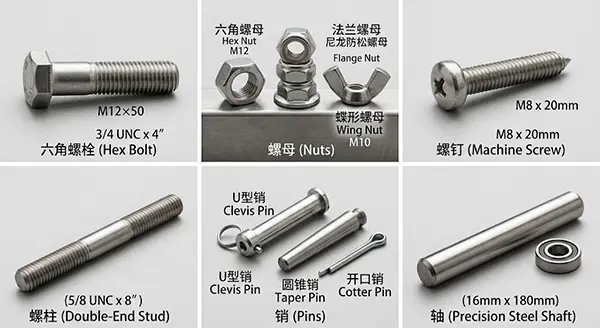
At HETAI, CNC turning and CNC milling can be used to manufacture custom bolts, screws, nuts, studs, pins, shafts, and other precision hardware components. Depending on the design, additional operations such as drilling, tapping, threading, grooving, chamfering, and slotting can also be performed.
This makes CNC machining particularly useful for prototypes, samples, replacement parts, maintenance components, and small production runs.
For example, if a customer needs 20, 50, or 200 pieces of a specially designed fastener, investing in a dedicated cold-heading die may not be economically justified. CNC machining can often produce the required parts with much lower initial tooling costs.
When Is Cold Heading Better?
Cold heading is highly efficient for high-volume production because specialized dies can form large quantities of parts quickly and with good material utilization. However, the initial investment in tooling can be relatively high.
For low-volume custom fasteners, this tooling cost may be spread over only a small number of parts, increasing the unit cost.
Therefore, cold heading is generally more suitable when the production quantity is large enough to justify the tooling investment. If the same custom fastener will be produced repeatedly in large quantities, HETAI may recommend cold heading or cold forming instead of CNC machining.
What About CNC Turning and CNC Milling?
For many low-volume custom fasteners, CNC turning is the first choice when the component is primarily cylindrical. It is suitable for producing features such as external diameters, shoulders, grooves, chamfers, and threads.
CNC milling becomes useful when the fastener requires flat surfaces, slots, pockets, keyways, cross features, or complex profiles.
Some custom fasteners require both turning and milling. In these cases, HETAI can combine multiple CNC operations to produce the complete component according to the customer’s drawing.
Other Manufacturing Processes
CNC machining is not the only option for low-volume production. Depending on the design, HETAI may also consider cold forming, grinding, drilling, tapping, thread rolling, or secondary machining.
For some simple designs, a standard fastener may be modified through secondary machining rather than manufactured completely from raw material. This can sometimes reduce production time and cost.
The material also influences the manufacturing process. Stainless steel, carbon steel, alloy steel, brass, aluminum, and other materials have different machining and forming characteristics. HETAI evaluates the material before determining the most appropriate process.
How HETAI Chooses the Best Process
When customers request low-volume custom fasteners, we consider several factors, including:
- Part geometry and complexity
- Material and mechanical requirements
- Required dimensional tolerances
- Production quantity
- Tooling requirements
- Surface finish
- Lead time
- Total manufacturing cost
For most low-volume projects, CNC machining provides the best combination of flexibility, precision, and low tooling investment. However, there is no single manufacturing process that is best for every application.
At HETAI, we evaluate each custom fastener individually and select CNC machining, cold heading, cold forming, or a combination of processes according to the actual design and production requirements.
Our goal is to provide the most practical manufacturing solution while maintaining the required quality, dimensional accuracy, mechanical performance, production efficiency, and cost-effectiveness.




Comments (0)