
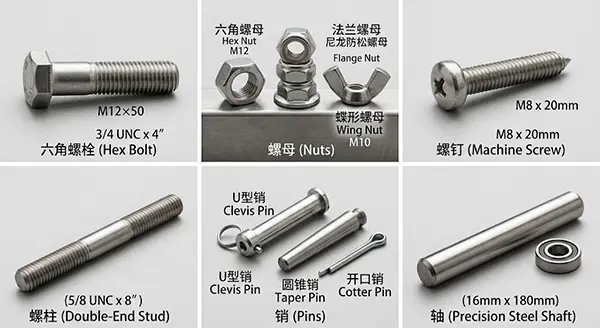
At HETAI, we use cold heading when a custom fastener requires high-volume production, consistent dimensions, good mechanical strength, and efficient material utilization. Cold heading is one of the most common manufacturing processes for producing bolts, screws, studs, pins, rivets, and other cold-formed fastener components.
The decision to use cold heading depends on the fastener’s geometry, material, required quantity, dimensional tolerances, mechanical requirements, and overall production cost.
What Is Cold Heading?
Cold heading, also called cold forming, is a metal forming process in which wire or rod is cut into individual blanks and formed into the required shape at room temperature. Instead of removing material through machining, the material is displaced and reshaped using specialized dies and punches.
For example, a bolt head can be formed from a cylindrical wire blank by applying controlled pressure inside a forming die. Depending on the design, multiple forming operations may be used to create the head, shoulder, flange, or other features.
At HETAI, cold heading can be combined with processes such as thread rolling, trimming, drilling, tapping, turning, milling, and surface treatment to produce finished custom fasteners.
When Is Cold Heading a Good Choice?
Cold heading is particularly suitable when the customer needs large production quantities. Once the appropriate tooling has been designed and manufactured, cold heading can produce a large number of identical parts at a high production speed. This can make it more economical than CNC machining for mass-production applications.
It is also a good choice when material efficiency is important. Because cold heading forms the material rather than cutting most of it away, it can significantly reduce material waste compared with machining a fastener from solid bar stock.
Another important advantage is mechanical performance. Cold forming can maintain and, in some cases, improve the material’s grain flow around the formed geometry. This can provide favorable mechanical properties for applications where fastener strength and durability are important.
Cold heading is also suitable when customers require high dimensional consistency. Properly designed tooling and controlled production conditions allow large quantities of parts to be manufactured with repeatable dimensions.
When Is Cold Heading Not the Best Option?
Cold heading is not automatically suitable for every custom fastener.
For very small quantities, the cost of developing dedicated forming dies may make cold heading uneconomical. In such cases, CNC machining may be a more practical solution.
Cold heading can also become challenging when a custom fastener has a highly complex geometry, deep cross holes, complicated internal features, or dimensions that cannot be efficiently produced through forming. These features may require secondary machining operations.
Material selection is another consideration. The material must have suitable ductility and forming characteristics to withstand the deformation without cracking or other defects.
Cold Heading vs. CNC Machining
At HETAI, we normally evaluate the complete part design before selecting the manufacturing process. Cold heading is generally advantageous for high-volume production of relatively repeatable geometries, while CNC machining provides greater flexibility for complex shapes and lower-volume custom parts.
In some cases, the most efficient solution is not to choose only one process. A custom fastener may be cold headed to form its basic geometry and then CNC machined to produce precise holes, slots, grooves, or other special features.
How HETAI Selects the Manufacturing Process
When a customer sends us a drawing, sample, or 3D model, HETAI evaluates the material, dimensions, tolerances, geometry, annual quantity, mechanical requirements, and required surface finish.
Based on these factors, we determine whether cold heading, CNC machining, or a combination of manufacturing processes is the most suitable solution.
For customers requiring high-volume custom fasteners with consistent quality and competitive production costs, cold heading can be an excellent manufacturing method. However, the best process depends on the specific design and production requirements of each part.
At HETAI, our goal is not simply to manufacture a custom fastener, but to select an appropriate production process that provides the right balance of quality, strength, precision, material efficiency, production capacity, and cost.




Comments (0)