
When manufacturing custom fasteners, choosing the right production process is important for achieving the required dimensions, mechanical properties, production efficiency, and cost. At HETAI, two commonly used manufacturing methods are CNC machining and cold forging. Each process has its own advantages and is suitable for different types of custom fasteners.
The best choice depends on factors such as part geometry, material, tolerances, production volume, and application requirements.
What Is CNC Machining?
CNC machining uses computer-controlled machine tools to remove material from a workpiece and create the required shape. CNC turning, milling, drilling, tapping, and other machining operations can be combined to produce complex custom fasteners.
At HETAI, CNC machining is particularly suitable for low- to medium-volume production, complex geometries, tight dimensional tolerances, and customized designs.
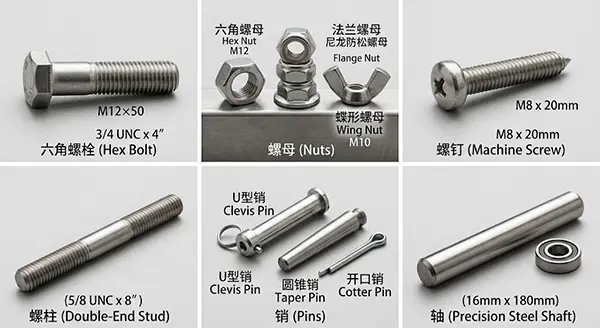
One of the main advantages of CNC machining is flexibility. The same machine can produce different designs by changing the CNC program and tooling. This makes CNC machining useful for prototypes, replacement parts, special bolts, precision nuts, threaded shafts, pins, and other non-standard components.
However, because CNC machining removes material from the workpiece, it can generate more material waste than a forming process. Production costs can also become higher when large quantities are required.
What Is Cold Forging?
Cold forging, also known as cold heading or cold forming, shapes metal at room temperature by applying high pressure through specialized dies and punches.
Cold forging is widely used for producing bolts, screws, rivets, and other fasteners in high volumes. Instead of removing material, the process reshapes the metal into the required geometry.
This provides several important advantages, including high production efficiency, excellent material utilization, consistent dimensions, and good mechanical properties.
Cold forging is particularly cost-effective for large production runs where the same custom fastener is manufactured repeatedly. However, specialized dies and tooling are normally required, which means the initial tooling cost can be higher.
CNC Machining vs. Cold Forging
The main differences can be summarized as follows:
| Factor | CNC Machining | Cold Forging |
|---|---|---|
| Production volume | Low to medium | Medium to high |
| Design flexibility | Very high | Moderate |
| Complex geometry | Excellent | Depends on die design |
| Initial tooling cost | Lower | Higher |
| Material utilization | Moderate | Excellent |
| Production speed | Relatively slower | Very high |
| Dimensional accuracy | Excellent | Excellent when properly controlled |
| Prototyping | Excellent | Less suitable |
| Mass production | More expensive | Highly cost-effective |
Which Process Is Better for Custom Fasteners?
There is no universal answer. CNC machining is often the better choice for complex designs, prototypes, small production quantities, or applications requiring extensive customization.
Cold forging is generally more suitable for high-volume production, especially when the fastener has a geometry that can be efficiently formed using dies.
In some cases, HETAI may combine both processes. For example, a fastener can be cold forged to create its basic shape and then CNC machined to produce precise features, holes, grooves, or other critical dimensions.
How Does HETAI Choose the Right Process?
At HETAI, we evaluate the design, material, dimensions, tolerances, quantity, mechanical requirements, tooling requirements, and application before recommending a manufacturing process.
Our goal is not simply to select the cheapest production method. We aim to find the best balance between quality, performance, production efficiency, lead time, and total cost.
Whether you need a CNC-machined custom fastener, a cold-forged bolt, or a combination of manufacturing processes, HETAI can provide a suitable production solution based on your specific requirements.
Have a custom fastener project? Send HETAI your drawing, sample, or specifications. Our engineering team can evaluate your requirements and recommend CNC machining, cold forging, or a combination of both.




Comments (0)