
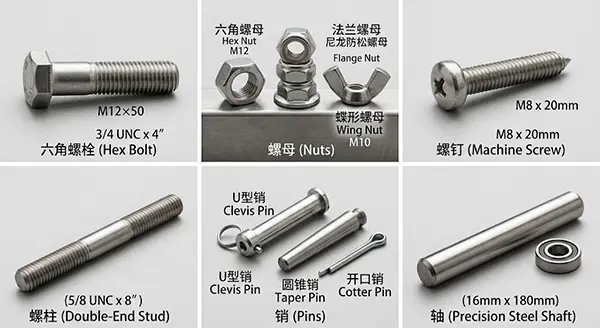
At HETAI, we use CNC machining when a custom fastener requires complex geometries, tight dimensional tolerances, special features, or relatively low-to-medium production volumes. CNC machining is one of the most flexible manufacturing methods for producing custom bolts, screws, nuts, pins, shafts, and other precision hardware components.
Unlike cold heading, which forms metal by applying pressure through specialized dies, CNC machining removes material from a workpiece using computer-controlled cutting tools. This allows manufacturers to produce highly customized shapes without investing in dedicated forming dies.
What Is CNC Machining for Custom Fasteners?
CNC machining uses computer-controlled equipment to accurately cut and shape materials such as stainless steel, carbon steel, alloy steel, brass, aluminum, and other engineering materials.
Depending on the design, HETAI can use CNC turning, CNC milling, drilling, tapping, threading, grooving, and other precision machining operations to manufacture custom fasteners.
For example, a custom fastener may require an unusual head shape, multiple diameters, internal threads, cross holes, slots, grooves, or other features that are difficult or inefficient to produce through conventional cold forming. CNC machining provides the flexibility needed to manufacture these features directly from the customer’s engineering drawing or 3D model.
When Is CNC Machining a Good Choice?
CNC machining is particularly suitable when a custom fastener has a complex or non-standard geometry. Because the cutting tools are controlled by programmed machining instructions, different shapes and features can be produced without creating a dedicated forming die for every design.
CNC machining is also a good option for small and medium production runs. For prototypes, samples, replacement parts, and customized components, the tooling investment required for cold heading may not be economically justified. CNC machining can often start production with significantly less dedicated tooling.
Another important advantage is dimensional precision. When a custom fastener requires tight tolerances or accurately positioned features, CNC machining can provide excellent repeatability when the machine, tooling, material, and inspection process are properly controlled.
CNC machining is also useful when a fastener requires secondary features. These may include precision holes, cross-drilled holes, slots, flats, shoulders, grooves, recesses, or other specially machined surfaces.
CNC Turning vs. CNC Milling
At HETAI, the machining method depends on the geometry of the custom fastener.
CNC turning is commonly used for cylindrical components such as custom screws, studs, pins, shafts, and threaded fasteners. The workpiece rotates while cutting tools remove material to create diameters, shoulders, grooves, chamfers, and threads.
CNC milling is generally used when a component requires flat surfaces, slots, pockets, keyways, complex profiles, or features that cannot be efficiently produced by turning alone.
For some custom fasteners, HETAI combines turning and milling operations to achieve the required geometry and dimensional accuracy.
When Is CNC Machining Better Than Cold Heading?
The choice between CNC machining and cold heading depends on the product design and production requirements.
Cold heading is generally more economical for high-volume production of fasteners with suitable geometries because it offers high production speed and efficient material utilization. CNC machining, however, provides greater flexibility for complex designs, lower production quantities, and special dimensional requirements.
For some products, the most efficient solution is a combination of manufacturing processes. A fastener can be cold formed to create its basic shape and then CNC machined to add precision holes, slots, grooves, or other special features.
How HETAI Selects the CNC Machining Process
When a customer contacts HETAI for a custom fastener, we review the engineering drawing, 3D model, material specification, dimensions, tolerances, production quantity, surface finish, and application requirements.
We then determine whether CNC turning, CNC milling, cold heading, cold forming, or a combination of processes is the most suitable manufacturing solution.
For customers requiring custom fasteners with complex geometries, tight tolerances, special machining features, prototypes, or small-to-medium production quantities, CNC machining can provide an efficient and flexible solution.
At HETAI, our goal is to select the manufacturing process that provides the best balance of precision, performance, production efficiency, material utilization, quality, and cost for every custom fastener project.




Comments (0)