
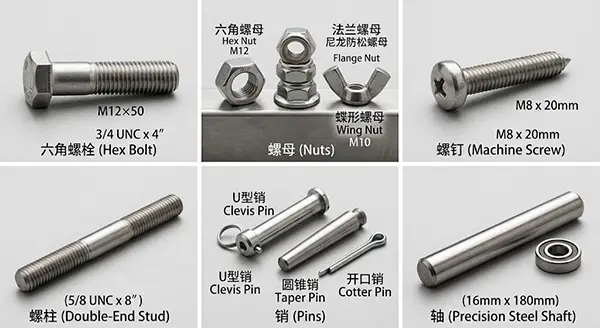
Custom fasteners can be manufactured using a variety of processes depending on the product design, material, dimensions, tolerances, production volume, and application requirements. At HETAI, we select the most suitable manufacturing process based on the specific requirements of each custom fastener rather than using one process for every product.
From cold heading and CNC machining to thread rolling, drilling, milling, heat treatment, and surface finishing, different processes can be combined to produce custom bolts, nuts, screws, studs, pins, shafts, and other precision fastening components.
1. Cold Heading
Cold heading, also known as cold forming, is widely used for producing high-volume fasteners. Metal wire is cut into blanks and formed at room temperature using dies and punches.
This process can efficiently create the basic shape of bolts, screws, rivets, and other formed components. Cold heading offers high production efficiency, good material utilization, and consistent dimensions, making it suitable for large-volume production.
2. CNC Machining
CNC machining is an important manufacturing method for custom fasteners with complex geometries or tight dimensional requirements.
At HETAI, CNC turning can be used to manufacture shafts, studs, pins, special bolts, and other rotational components. CNC milling can create flats, slots, holes, grooves, and other complex features that cannot be produced efficiently through conventional forming processes.
CNC machining is particularly useful when a custom fastener requires precise dimensions or a relatively small production quantity.
3. Thread Rolling and Thread Cutting
Threads are one of the most important features of a fastener. Depending on the material and design, HETAI may use thread rolling or thread cutting.
Thread rolling forms threads by pressing the workpiece between hardened dies. It generally provides high production efficiency and can produce strong, consistent threads.
Thread cutting removes material to create the thread profile. It is useful for certain materials, special thread specifications, large-diameter components, or custom designs that are not suitable for standard rolling processes.
4. Drilling, Tapping, and Milling
Additional machining operations may be required to complete a custom fastener.
Drilling creates holes or internal passages, while tapping produces internal threads. Milling can create slots, flats, keyways, pockets, or other special features.
These processes are often combined with CNC turning or other manufacturing methods to produce more complex custom components.
5. Heat Treatment
Some custom fasteners require specific mechanical properties such as increased hardness, tensile strength, or wear resistance.
Depending on the material and application, HETAI may use heat-treatment processes such as quenching, tempering, annealing, or other specified treatments.
The appropriate heat-treatment process depends on the material, required mechanical properties, dimensions, and application conditions.
6. Surface Treatment and Finishing
Surface treatment can improve corrosion resistance, appearance, wear resistance, or other performance characteristics.
Depending on customer requirements, custom fasteners may receive treatments such as zinc plating, black oxide, passivation, nickel plating, coating, or other surface finishes.
Surface treatment is selected according to the material and the environment in which the custom fastener will be used.
7. Inspection and Quality Control
Manufacturing is followed by inspection and quality control. HETAI can check critical dimensions, thread specifications, surface condition, hardness, and other requirements according to the customer’s drawings and specifications.
For demanding applications, additional inspection or testing may be performed before shipment.
Choosing the Right Manufacturing Process
There is no single manufacturing process suitable for every custom fastener. The optimal process depends on factors such as design complexity, material, dimensions, tolerance, production quantity, required mechanical properties, surface treatment, and application.
At HETAI, we evaluate these factors before production and may combine several processes to achieve the required result.
Whether you need a custom bolt produced by cold forming, a precision CNC-machined screw, a special nut, a threaded shaft, or another non-standard component, HETAI can provide a customized manufacturing solution from engineering and prototyping through production and inspection.
Have a custom fastener project? Send HETAI your drawing, sample, or specifications, and our engineering team can help determine the most suitable manufacturing process for your application.





Comments (0)