
At HETAI, we often recommend stainless steel when corrosion resistance is a primary requirement for custom fasteners. However, there is no single material that is best for every application. The right choice depends on the environment, exposure to moisture or chemicals, operating temperature, mechanical requirements, manufacturing process, and overall cost.
For most general applications, 304 stainless steel provides a good combination of corrosion resistance, strength, machinability, and cost. When the fastener will be exposed to saltwater, chlorides, marine environments, or more aggressive conditions, 316 stainless steel is often a better choice.
Why Is Stainless Steel Used for Corrosion-Resistant Fasteners?
Stainless steel contains chromium, which allows a thin passive oxide layer to form naturally on the material’s surface. This layer helps protect the underlying metal from corrosion.
Unlike carbon steel, stainless steel does not normally require a protective coating to provide its basic corrosion resistance. This makes stainless steel particularly useful for applications where long-term exposure to moisture or corrosive environments is expected.
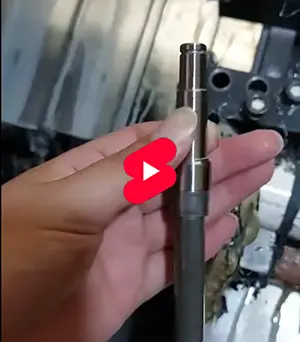
At HETAI, stainless steel can be used to manufacture custom bolts, screws, nuts, studs, pins, shafts, and other precision components according to customer drawings and specifications.
304 Stainless Steel
304 stainless steel is one of the most commonly selected materials for corrosion-resistant custom fasteners.
It provides good resistance to moisture, atmospheric corrosion, and many common chemicals. It also offers good mechanical properties and can be machined or formed for many different fastener designs.
304 stainless steel is commonly used in industrial equipment, machinery, food-processing equipment, electrical equipment, architectural applications, and general outdoor environments.
For customers looking for a practical balance between corrosion resistance and cost, 304 stainless steel is often an excellent starting point.
316 Stainless Steel
When the operating environment is more demanding, 316 stainless steel may be a better option.
The addition of molybdenum gives 316 stainless steel improved resistance to pitting and crevice corrosion in many chloride-containing environments. This makes it particularly useful for marine applications, coastal environments, chemical processing equipment, and applications exposed to salt or seawater.
However, 316 stainless steel generally costs more than 304. Therefore, the additional corrosion resistance should be justified by the actual operating environment.
Other Corrosion-Resistant Materials
Stainless steel is not the only option. Depending on the application, HETAI may also consider brass, bronze, aluminum, and specialty alloys.
Brass and bronze can provide good corrosion resistance and are often used for electrical, plumbing, marine, and decorative components.
Aluminum naturally forms a protective oxide layer and provides good corrosion resistance while offering the advantage of low weight. Different aluminum alloys can provide different combinations of strength, machinability, and corrosion resistance.
For highly demanding applications, specialty alloys may be considered when exceptional resistance to specific chemicals, high temperatures, or extreme environments is required.
Does Surface Treatment Improve Corrosion Resistance?
Yes. For carbon steel and some other materials, surface treatments can significantly improve corrosion resistance.
Depending on the application, HETAI may consider treatments such as zinc plating, passivation, black oxide, phosphate coating, or other protective finishes.
However, surface treatment should be selected together with the base material and operating environment. A coating that works well in one application may not provide sufficient protection in another.
How Does HETAI Select the Best Material?
When selecting a material for corrosion-resistant custom fasteners, HETAI evaluates:
- Exposure to water, humidity, salt, or chemicals
- Required corrosion resistance
- Mechanical strength
- Operating temperature
- Contact with dissimilar metals
- Manufacturing process
- Surface treatment requirements
- Dimensional and tolerance requirements
- Production quantity
- Overall cost
For many applications, 304 stainless steel is a practical general-purpose choice, while 316 stainless steel is often preferred for marine, saltwater, and chloride-rich environments.
At HETAI, we do not select materials based on corrosion resistance alone. We consider the complete application and manufacturing requirements to determine the most appropriate solution.
The best corrosion-resistant material is ultimately the one that provides the required corrosion resistance, mechanical performance, manufacturing compatibility, service life, and cost-effectiveness for the specific application.




Comments (0)