China Issues Compliance Guidelines for Automotive Overseas Operations: Shifting from “Going Global” to “Compliant Globalization”
China recently issued the Guiding Opinions on Standardizing Competitive Behavior in Overseas Operations of the Automotive Industry, presenting systematic requirements for Chinese automakers across multiple dimensions, including overseas market competition, product pricing, production safety, quality management, labor protection, and data security. This signifies that the internationalization of China’s auto industry is evolving from a pure pursuit of export volumes toward a new phase that prioritizes compliant operations, brand building, and localized development.
20 Guidelines Standardize Automakers’ Overseas Competitive Behavior
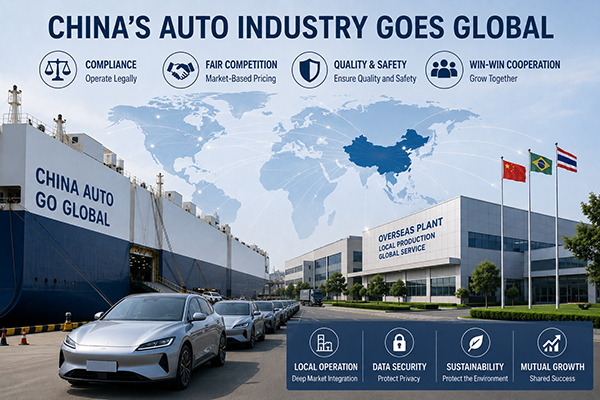
According to a notice released by China’s Ministry of Commerce and two other government departments, the newly issued guidelines consist of 20 provisions. Primarily targeting Chinese automakers operating overseas, these guidelines regulate activities across overseas marketing, production, operations, and market competition.
Regarding market competition, the guidelines encourage automakers to adhere to market supply and demand dynamics, adopt cost-based pricing strategies, and avoid disrupting market order through unfair competitive practices.
When determining the Manufacturer’s Suggested Retail Price (MSRP) in overseas markets, enterprises should comply with local laws and regulations while respecting market dynamics and commercial norms. Automakers should establish a clear and reasonable pricing structure for different vehicle configurations and refrain from frequent or drastic price adjustments that could harm consumer interests.
Furthermore, enterprises must respect the pricing autonomy of overseas distributors and dealers. Promotional activities must also align with local laws, regulations, and socio-cultural and business customs.
These provisions demonstrate that the future competitive strategy for Chinese automakers in overseas markets will place greater emphasis on price stability, dealer relationships, and long-term brand equity, rather than focusing solely on sales volumes and market share.
Overseas Production and Localization Become Primary Focus
The guidelines extend regulatory coverage beyond vehicle export sales to encompass overseas manufacturing and localized operations.
Automakers are required to conduct operations tailored to local conditions and embed compliance requirements into every stage of their business lifecycle. In overseas manufacturing processes, enterprises must strengthen management across production safety, product quality, labor protection, environmental protection, taxation, and employment.
Given the rapid development of new energy vehicles (NEVs) and intelligent connected vehicles (ICVs), data compliance has become increasingly critical.
For data processing involving ICVs and autonomous driving, companies must comply with relevant local laws and regulations while bolstering consumer personal information protection. Consequently, as Chinese automakers expand into markets such as Europe and Southeast Asia, they must navigate not only product certifications and trade barriers, but also increasingly complex requirements around cross-border data flows, privacy protection, and data localization.
Continuous Expansion of China’s Automotive Export Scale
China’s auto industry has accelerated its global expansion in recent years.
Customs data shows that China’s auto exports reached 8.32 million units in 2025, shipping to more than 200 countries and regions worldwide. Simultaneously, Chinese enterprises have made investments in automobile manufacturing across more than 80 countries and regions.
Notably, the global expansion model of Chinese automakers is undergoing a strategic shift.
In the past, exporting complete vehicles (CBU) served as the primary entry mode into overseas markets. Today, an increasing number of automakers are constructing overseas factories and building out local component supply chains and sales-service networks, accelerating the localization of manufacturing, supply chains, and aftermarket services.
For instance, in July this year, Geely Auto and U.S.-based Ford Motor announced a new cooperation agreement in Spain, exemplifying the trend of Chinese automakers deepening their local presence in Europe.
Shift from Product Exports to Industrial Chain Globalization
Industry experts view these guidelines as complementary to previous policies issued by the Ministry of Commerce regarding anti-corruption compliance and corporate social responsibility (CSR) in overseas operations. Together, they form a comprehensive compliance support framework for Chinese enterprises expanding abroad.
Shi Yonghong, Vice President of the China Chamber of Commerce for Import and Export of Machinery and Electronic Products (CCCME), noted that overseas plant construction and localized management involve highly complex compliance demands, including environmental standards, taxation, labor relations, and data localization. By covering the entire operational lifecycle of auto enterprises, these guidelines will help facilitate the coordinated overseas expansion of vehicle assembly, component supply, and aftermarket service networks.
Commentary: China’s Automotive “Going Global” Enters the Second Half
From an industry trajectory perspective, the guidelines send a clear message: the globalization of China’s automotive industry is transitioning from “scale-driven expansion” to “capability-driven expansion.”
In the past, Chinese automakers relied heavily on cost efficiency, supply chain advantages, and manufacturing speed for overseas competitiveness. However, as Chinese brands gain higher market share globally, relying solely on low pricing is no longer a viable strategy for long-term competitive advantage.
Moving forward, Chinese automakers must build comprehensive global capabilities across technology, quality, brand power, sales channels, service networks, compliance, and localized operations.
Especially in Europe, North America, and select emerging markets, automotive competition goes beyond product features—it intersects with trade policy, industrial strategy, data security, environmental standards, labor laws, and consumer protection.
Therefore, regulating competitive behavior abroad does not aim to restrict the expansion of Chinese automakers; rather, it facilitates the establishment of stable, transparent, and sustainable overseas operational frameworks.
For China’s automotive industry, true globalization goes beyond simply selling cars overseas. It requires establishing comprehensive overseas ecosystems covering R&D, manufacturing, supply chains, sales, service, and brand management, while deeply integrating into local economic and social environments.
This signals that global competition for Chinese automakers is entering a more mature phase: evolving from “Made in China” to “Designed, Manufactured, and Operated Globally.”